
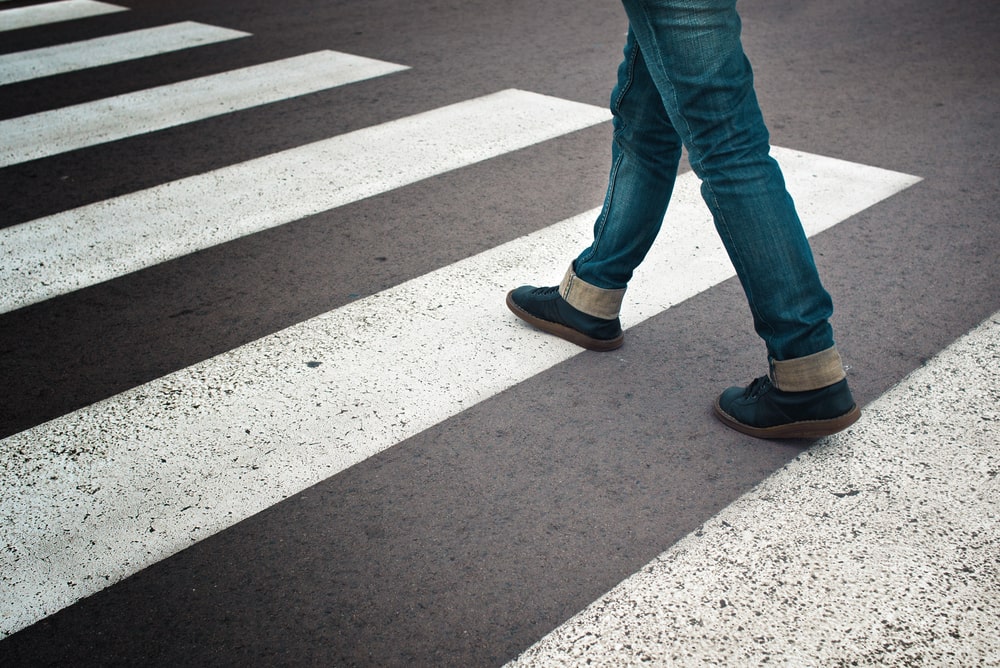
Most people assume pedestrians always have the right of way. Texas law is more conditional than that. Under Texas Transportation Code Chapter 552, both drivers and pedestrians carry legal duties, and fault in an accident depends heavily on the specific circumstances.
At crosswalks and controlled intersections, drivers must stop and yield to pedestrians who are crossing lawfully. But pedestrians cannot suddenly step into traffic when a vehicle is close enough that stopping is not reasonably possible. The law expects both parties to act responsibly. Key rules under Texas law include:
- Drivers must stop and yield to a pedestrian in a crosswalk, and must remain stopped until the pedestrian has finished crossing
- A pedestrian may not suddenly leave a curb or other place of safety and enter a crosswalk in the path of a vehicle so close that the driver cannot stop and yield
- Pedestrians must use sidewalks when they are available and accessible
- When walking along a road without a sidewalk, a pedestrian must walk on the left side of the roadway or shoulder, facing oncoming traffic, unless that side is obstructed or unsafe
Marked Crosswalks, Unmarked Crosswalks, and Mid-Block Crossings
Texas law does not require paint. Section 541.302(2) defines a crosswalk to include both a roadway area marked by surface markings and the portion of a roadway at an intersection lying within the connections of the lateral sidewalk lines. That second category is the unmarked crosswalk. It exists at any intersection where the sidewalks would continue across the street, painted or not.
Section 552.005 requires a pedestrian to yield only when crossing somewhere other than a marked or unmarked crosswalk, or where a tunnel or overhead crossing is provided. So:
- At an intersection, marked or not, the driver must stop and yield. The pedestrian is not jaywalking.
- Mid-block, the pedestrian yields.
Two limits apply: between adjacent signalized intersections a pedestrian may cross only in a marked crosswalk, and diagonal crossing requires a traffic control device. If you were struck at a corner with no painted lines, you were likely in a crosswalk, a fact often missed in the initial police narrative.
What the Driver’s Duty Actually Requires
- Passing a stopped car: If the car ahead of you stops at a crosswalk to let someone cross, Texas Transportation Code § 552.003(c) prohibits you from passing it. This is how many crosswalk injuries happen. The first driver stops, the second goes around and strikes a pedestrian who reasonably believed traffic had yielded.
- Walk signals: When a pedestrian steps off on a “Walk” signal, § 552.002(b) requires you to stop and yield. The signal does not merely permit the crossing; it creates a duty on the driver.
- Turning on a green light: A green light is not permission to turn through people. Under § 544.007, a driver facing a circular green or a green arrow must stop and yield to pedestrians lawfully in the intersection or an adjacent crosswalk. This is the rule that governs the common turning collision.
- General due care: Separate from any right-of-way rule, § 552.008 requires every driver to exercise due care to avoid colliding with a pedestrian, sound the horn when necessary, and take added precaution on observing a child or an obviously confused or incapacitated person on the roadway.
Sidewalk Users: Bicycles, Scooters, and Skateboards
Effective September 1, 2025, S.B. 2039 added Section 552.0035 to the Transportation Code, extending crosswalk right-of-way protection beyond people traveling on foot. Drivers owe the same stop-and-yield duty, and the same no-passing rule, to someone crossing a crosswalk on a bicycle, scooter, or skateboard. Section 541.001(6) defines a sidewalk user as an individual lawfully operating a bicycle, motor-assisted scooter, electric personal assistive mobility device, or skateboard on a sidewalk. A person using a wheelchair is considered a pedestrian and is covered by § 552.003.
Duties run both ways. A sidewalk user may not suddenly leave a curb into a vehicle’s path, and entering a crosswalk above eight miles per hour is prima facie evidence that the speed was not reasonable. Under § 552.0036, a sidewalk user facing a stop sign must stop before the crosswalk and yield to any vehicle already in the intersection or approaching closely enough to be an immediate hazard.
Pedestrian Accidents in Parking Lots
Two different rules apply here, and they do not line up.
Stop-and-render-aid duties do reach business lots. Section 550.001 applies Chapter 550 to a private access way or parking area a business provides for clients or patrons, excluding private residential property and paid parking garages and lots. A driver who strikes a pedestrian in a store’s customer lot owes the same duties to stop, check whether aid is needed, remain at the scene, exchange information, and render assistance as a driver on a public street.
Whether the crosswalk rules reach that same lot is an open question. Section 542.001 limits Subtitle C, which contains the crosswalk provisions, to operation on a highway unless a provision states otherwise. Chapter 550 says expressly that it reaches business parking areas; Chapter 552 does not. A striped crosswalk in a store lot may not carry the statutory stop-and-yield duty the identical stripes carry on the street.
That does not defeat a claim. Ordinary negligence still applies on private property, and the painted crosswalk, signage, and the store’s own traffic design remain strong evidence of what a reasonable driver should have done. The claim simply runs through common-law negligence rather than a statutory violation.
Criminal Exposure After a Pedestrian Collision
A civil claim and a criminal case can arise from the same collision.
Failure to stop and render aid, Section 550.021. A driver in a collision that results, or is reasonably likely to result, in injury to or death of a person must stop at or near the scene, determine whether anyone requires aid, and remain until the duties in Section 550.023 are met. Penalties are graduated:
- Death, second-degree felony
- Serious bodily injury (Penal Code § 1.07), third-degree felony
- Other injury, up to five years in prison or one year in county jail, a fine up to $5,000, or both
Injuring a pedestrian in a crosswalk, Section 545.428. Also from the Lisa Torry Smith Act: a person who, with criminal negligence, operates a motor vehicle within the area of a crosswalk and causes bodily injury to a pedestrian or other vulnerable road user (a cyclist, scooter rider, or operator of an electric personal assistive mobility device, neighborhood electric vehicle, or golf cart) commits a Class A misdemeanor, or a state jail felony where the injury is serious. An affirmative defense applies if the injured person was violating a rule governing walking or movement in a crosswalk or on a roadway, which is another reason the marked-versus-unmarked question matters.
Enhanced penalties. Under § 552.003(d), a failure to stop and yield that seriously injures or kills a visually impaired or disabled person is a misdemeanor punishable by a fine of up to $500 and 30 hours of community service, completed within six months to one year, part of which must be sensitivity training.
Criminal negligence is a real threshold. A driver may face no charge at all and still be liable civilly, where the standard is ordinary negligence.
What Happens When a Driver Fails to Yield
When a driver does not stop and yield to a pedestrian who has the legal right of way, the consequences can be serious. Pedestrians have no physical protection in a collision. Even low-speed impacts can cause broken bones, traumatic brain injuries, and long-term mobility issues.
If you were struck while crossing lawfully, a driver’s failure to stop and yield forms a strong basis for a civil claim. Police reports, witness statements, and traffic camera footage all become important evidence in building that case. An Ellis County pedestrian accident lawyer can review the specific facts and help determine what damages may be recoverable.
Shared Fault and What It Means for Your Case
Texas follows a modified comparative fault rule: the 51% bar under Chapter 33 of the Civil Practice and Remedies Code. If a pedestrian is found more than 50% responsible for an accident, they cannot recover compensation. If they are 30% at fault, their award is reduced by that percentage.
This is why the details matter. Was the crossing at an intersection, so that an unmarked crosswalk existed? Was the pedestrian signal in your favor? Was there poor lighting? Was the driver speeding, turning, or distracted? Every factor can affect how fault is assigned and how much compensation is available.
Common Locations Where Pedestrian Accidents Happen in Texas
Certain environments carry higher risk:
- Busy intersections without dedicated pedestrian signals
- Parking lots near retail centers, the duty to stop and render aid expressly reaches business parking areas under § 550.001, while whether the crosswalk duties reach a striped crosswalk inside a private lot is an open question under § 542.001.
- School zones during drop-off and pick-up hours
- Roads adjacent to apartment complexes with no sidewalks
- Highway frontage roads in suburban areas
Getting Legal Help After a Pedestrian Accident
Understanding your rights is the first step after any pedestrian accident. Brandy Austin Law Firm represents clients across Texas in personal injury cases, including those involving pedestrian accidents where fault is disputed.
If you were injured as a pedestrian in the area, an Ellis County pedestrian accident lawyer at our firm can review your situation and explain what legal options may be available to you. Contact us today to get started.
By Brandy Austin, Personal Injury Lawyer — Brandy Austin Law Firm, PLLC
Legally reviewed on August 12, 2026