
Dallas Slip and Fall Lawyer

Brandy Austin Law Firm represents Dallas residents injured in slip and fall accidents resulting from hazardous property conditions, including wet floors, poor lighting, uneven surfaces, and obstructed walkways. Common injuries in these cases range from fractures and traumatic brain injuries to spinal cord damage. The firm applies Texas premises liability law to hold negligent property owners accountable, demonstrating that they knew or should have known about a dangerous condition and failed to address it. Under Texas’s modified comparative negligence rule, victims may recover damages provided they are less than 51% at fault. Claims must be filed within two years of the incident date.
Plaintiff-focused slip and fall lawyers serving injured clients across Dallas, TX, and the surrounding communities.
If you slipped and fell on someone else’s property in Dallas, you may be nursing physical injuries and dealing with financial loss. Our Dallas, TX slip and fall lawyer has spent years helping injured people hold negligent property owners accountable. At Brandy Austin Law Firm, we investigate, document, and push for the full value of your claim. Reach out for a free consultation to learn more about compensation.
Slip and Fall Lawyer Dallas, TX
A slip and fall case is a type of premises liability claim. It arises when a property owner or occupier fails to keep their premises reasonably safe and someone gets hurt as a result. The hazard might be a wet floor, a broken stair, or a poorly lit walkway. What matters under Texas law is whether the owner knew, or should have known, about the danger and failed to fix it or warn visitors.
Not every fall leads to a valid claim. The property owner has to have owed you a duty of care, and that duty depends on why you were on the property. A customer in a store is owed more protection than someone with no permission to be there. The duty owed to an invited guest or paying customer is the highest the law recognizes. Sorting out that distinction early shapes the entire case, which is why an experienced slip and fall attorney looks at it first.
Types of Slip and Fall Cases We Handle in Dallas
Falls happen in all kinds of places, and the cause is not always obvious. We handle slip and fall claims across Dallas involving private businesses, apartment complexes, public spaces, and rental properties. The setting changes, but the core question stays the same: whether the property was kept reasonably safe for those invited onto it.
- Wet and slippery floors. Spills, freshly mopped tile, and tracked-in rainwater create hazards that customers cannot always see. When a store leaves a spill unaddressed and skips the warning cone, that gap in basic upkeep often becomes the heart of the claim.
- Uneven or broken flooring. Cracked tile, torn carpet, and warped floorboards catch the foot and send people down hard. Owners who ignore known defects for months leave a clear trail of neglect that we can follow.
- Poorly maintained stairways. Loose handrails, worn treads, and missing steps turn an ordinary staircase into a serious risk. Stair falls tend to cause some of the worst injuries we handle, from fractures to head trauma.
- Inadequate lighting. A dark stairwell, parking garage, or hallway hides hazards that would be easy to avoid in proper light. Property owners are responsible for lighting the areas people use.
- Parking lot and sidewalk hazards. Potholes, crumbling curbs, and unmarked changes in elevation injure people before they ever reach the door. These exterior areas are part of the premises, and owners cannot ignore them.
- Debris and cluttered walkways. Boxes in an aisle, cords across a path, and merchandise left on the floor block safe passage. Stores control how their aisles are stocked, and they answer for what they leave underfoot.
- Weather-related hazards. Rain gets tracked into entryways, and owners who do nothing to dry or mat those areas invite falls. Texas weather swings fast, and entrances need attention when it does.
- Apartment and rental property falls. Landlords and property managers must keep common areas, stairwells, and walkways safe for tenants and guests. When they let conditions slide, injured residents have real options for recovery. A Dallas slip and fall attorney can pursue the manager, the owner, or both.
Why Choose Brandy Austin Law Firm as my Slip and Fall Lawyer in Dallas, TX?
Local Knowledge and Courtroom Experience
Brandy Austin Law Firm has handled personal injury and premises liability matters in the Dallas area for years. Brandy M. Austin has practiced law in Texas since 2008 and built this firm from the ground up. She is admitted in Texas state courts and several federal districts, and her background spans negotiation and trial work. A graduate of Baylor University School of Law, she has been recognized as a Fellow of the Texas Bar Foundation, a distinction reserved for a small share of attorneys in the state. That matters in slip and fall cases, where insurers settle differently once they know a firm is prepared to try the case. Our personal injury lawyer in Dallas, TX brings both preparation and persistence to the table.
Recognition and Results
Our record reflects steady, careful work rather than empty promises. Brandy M. Austin has been named a Rising Star by Super Lawyers and recognized among top attorneys in the Fort Worth area by Fort Worth Magazine. Over the years, the firm has recovered millions of dollars for injured clients across Texas. Your first consultation is free, and you can use it to ask questions and weigh your options before deciding whether to continue.
Slip and Fall Law Infographic
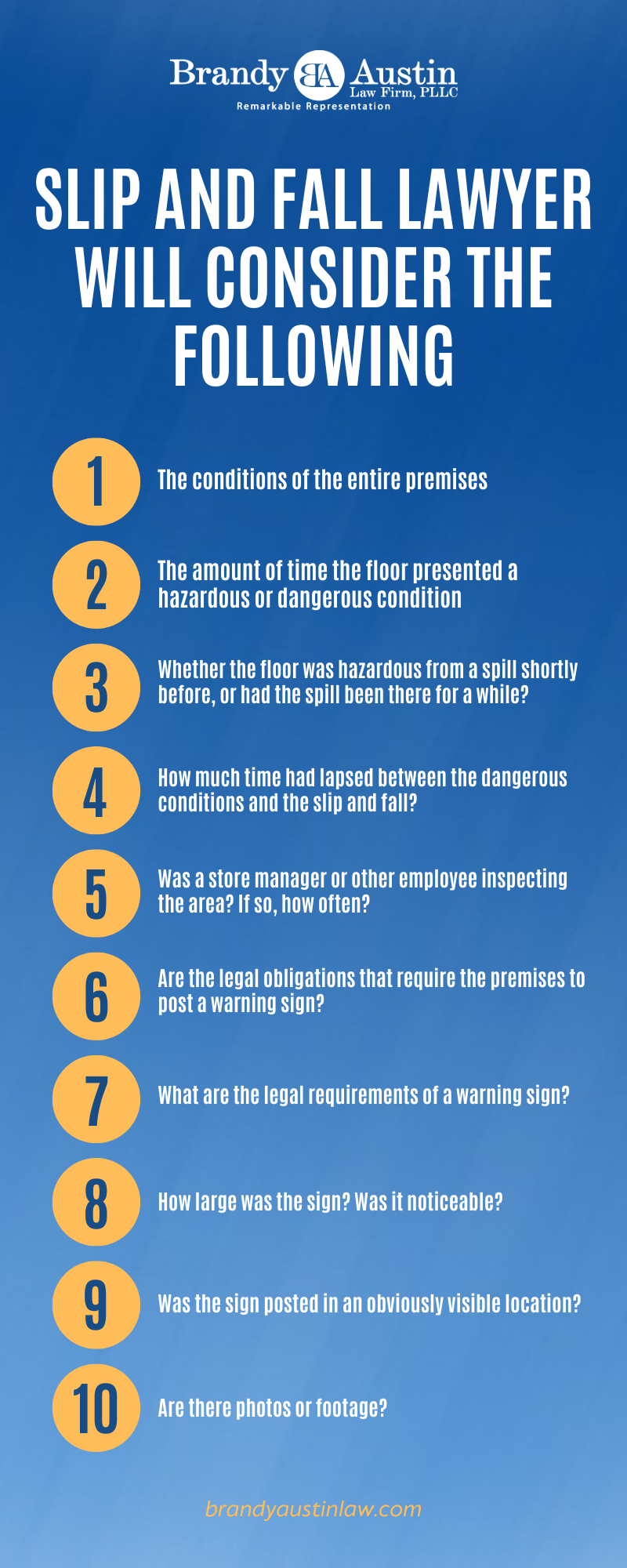
Understanding Slip and Fall Cases
Damages, Liability, and Compensation for Slip and Fall Cases
Liability in a slip and fall case comes down to negligence. We have to show the property owner owed you a duty, breached it by allowing a hazard, and caused your injury as a result. Liability often falls on the party that controlled the space, whether that is a store, a landlord, or a business owner. Once liability is established, the focus shifts to damages, which is the money meant to make you whole again. Texas recognizes both economic and non-economic damages. Economic damages cover measurable losses, while non-economic damages cover the harder-to-quantify toll an injury takes on your life. The categories we commonly pursue include:
- Medical bills, both current and future
- Lost wages and reduced earning capacity
- Pain and suffering and physical impairment
- Out-of-pocket costs tied to the injury
- Long-term care or rehabilitation needs
Texas follows a comparative fault rule, so any share of blame assigned to you reduces what you can recover. The value of any claim depends on the severity of the injury and the strength of the evidence. Some premises liability damages are easy to document, while others, like future medical needs, take careful proof. Reviewing the full range of types of damages early helps set realistic expectations.
Important Aspects of a Slip and Fall Case
Slip and fall claims rise or fall on evidence, and that evidence disappears quickly. For instance, a spill may get cleaned up, a broken step can be repaired, and in other ways essential proof is fixed or removed. Here are a few details that carry more weight than most people expect:
- Proof the owner knew, or should have known, about the hazard
- Security camera footage from the time of the fall
- Photos of the hazard before it was fixed
- Witness names and statements
- Medical records connecting the injury to the fall
Showing the owner had notice is often the hardest part of the case. Texas law generally requires proof that the property owner knew about the danger or had a reasonable chance to discover it. Building that record is exactly what premises liability claims demand, and it is why dangerous property conditions need to be documented before they vanish.
Slip and Fall Case Timeline
No two slip and fall cases move at the same pace, but most follow a recognizable path. Here is how a typical slip and fall claim tends to unfold:
- Investigation and evidence gathering soon after the injury
- Medical treatment and full documentation of your condition
- A demand sent to the property owner or their insurer
- Negotiation toward a fair settlement
- Filing a lawsuit if a reasonable offer never comes
Many claims resolve through settlement, but some require litigation to reach a fair result. Texas sets firm deadlines for filing, so the statute of limitations shapes the schedule from day one. Waiting too long can end a strong claim before it ever starts.
What to Bring to Your Slip and Fall Consultation
The first meeting goes more smoothly when you arrive prepared. Bring whatever you already have, even if it feels incomplete:
- Photos or video of the hazard and the scene
- Any incident report you filed with the property
- Medical records and bills related to the fall
- Contact details for any witnesses
If you have already taken steps after a fall like reporting it or seeing a doctor, bring proof of those too. Expect us to listen, ask questions, and give you an honest read on your options. A free personal injury consultation is the place to get answers, not a commitment.
Texas Legal Resources for Slip and Fall Cases
Texas law sets the rules that govern every slip and fall claim, and a few sources are worth knowing. These are starting points for understanding the law, not a substitute for advice on your own facts.
- Two-Year Deadline: The Texas law for filing injury suits sits in the Civil Practice and Remedies Code.
- Proportionate Responsibility: Texas explains how shared fault affects recovery.
- Damages Provisions: The state outlines what injured people can pursue.
Reach Out to Brandy Austin Law Firm to Schedule a Consultation
If a fall on someone else’s property left you hurt, the path forward starts with a conversation. At Brandy Austin Law Firm, your first consultation is free, and there is no pressure to decide anything right away. We will review what happened, explain your options, and answer your questions directly. Contact us to schedule a time that works for you.
Slip and Fall Accident Statistics in Dallas
 Falls send more people to Dallas emergency rooms than most residents realize. Nationwide, the Centers for Disease Control and Prevention documented over 3.85 million fall-related emergency department visits in a single year, and more than 43,000 older adults died from fall injuries in 2024 alone. The National Safety Council reports that preventable fall deaths have climbed 51 percent over the past decade, with annual medical costs now exceeding $50 billion. In Texas, the Bureau of Labor Statistics counted 412 fatal workplace falls in the construction sector during 2022, and the state’s booming commercial development in neighborhoods like Deep Ellum, Uptown, and the Design District means newly poured concrete, exposed surfaces, and heavy foot traffic create conditions where one misstep can change someone’s life.
- 800,000+ hospitalizations occur each year due to falls, with hip fractures and traumatic brain injuries ranking among the most common.
- $50 billion in annual medical costs stem from fall-related injuries nationwide, a figure the CDC expects to keep rising.
- 83 percent of hip fracture deaths in older adults are caused by falls, and roughly 319,000 hip fracture hospitalizations happen each year.
- 85 percent of workers’ compensation claims tied to slips and falls involve wet or slippery surfaces, according to the National Floor Safety Institute.
Property owners in Dallas have a legal obligation to maintain safe conditions for visitors. When they fail, an experienced injury attorney can help determine whether their negligence caused the injury.
Mistakes That Can Weaken Your Slip and Fall Claim
One wrong move after a fall on someone else’s property can undermine months of recovery and thousands of dollars in medical bills. These ten mistakes are the ones Dallas slip and fall lawyers see most often.
- Leaving the scene without documenting the hazard. The wet floor, cracked sidewalk, or missing handrail that caused the fall may be repaired within hours. Photographs taken at the scene with a timestamp are some of the strongest evidence in a premises liability case.
- Skipping or delaying medical treatment. Insurance adjusters look for gaps between the date of the fall and the first medical visit. Even a two-day delay can give the defense room to argue the injuries came from something else entirely.
- Giving a recorded statement to the property owner’s insurer. The claims adjuster is not a neutral party. A casual comment about “feeling fine” can be used to minimize a traumatic brain injury diagnosed weeks later.
- Throwing away the shoes or clothing worn during the fall. Defense attorneys sometimes argue that the victim’s footwear contributed to the accident. Keeping the shoes, pants, and any torn or stained clothing preserves physical evidence that may matter at trial.
- Assuming the property owner already knows about the hazard. In Texas, establishing that the owner knew or should have known about a dangerous condition is central to a negligence claim. Without evidence of notice, the case becomes much harder to prove.
- Failing to identify witnesses before leaving. A fellow shopper or employee who saw the fall can corroborate what happened. Names and phone numbers gathered at the scene carry more weight than a vague memory weeks later.
- Sharing details about the incident on social media. A post about returning to the gym or attending a weekend event gives defense counsel ammunition to argue the injuries are exaggerated.
- Accepting a quick settlement without understanding the full extent of injuries. Some slip and fall injuries, including herniated discs and nerve damage, do not show their full impact for months. Settling early often means accepting far less than the damages available under Texas law.
- Not requesting an incident report. Retail stores, hotels, and apartment complexes are required to document injuries that occur on their premises. Asking for a copy of the incident report creates an official record that the fall happened where and when you say it did.
- Handling the claim without legal help. Premises liability law in Texas involves questions about the visitor’s status on the property, the owner’s duty of care, and comparative fault rules that reduce compensation based on shared responsibility. These are not questions most people can navigate alone.
Dallas Slip and Fall Lawyer FAQs
How long do I have to file a slip and fall lawsuit in Texas?
Texas imposes a two-year statute of limitations on personal injury claims, including slip and fall accidents. The clock starts on the date of the fall. Missing that deadline almost certainly means the court will dismiss your case.
What does a slip and fall victim need to prove in court?
The injured person must show that the property owner owed a duty of care, that a dangerous condition existed, that the owner knew or should have known about it, and that the condition directly caused the injury. Building evidence early matters because each of those elements requires proof.
Can I recover compensation if I was partly at fault for the fall?
Texas follows a modified comparative fault rule. You can still recover damages as long as your share of responsibility stays below 51 percent. A jury that assigns you 20 percent of the blame reduces your award by that amount. An attorney can provide a comparative fault analysis for your situation.
What kinds of compensation are available in a slip and fall case?
Damages may include medical expenses, lost income, diminished earning capacity, physical pain and suffering, and mental anguish. In rare situations where the property owner’s conduct was especially reckless, punitive damages may also apply.
Do I need to prove the property owner created the hazard?
Not necessarily. Texas law holds property owners responsible when they knew about a hazard and failed to fix it or warn visitors, even if they did not create it. A grocery store that ignores a spill for thirty minutes has a harder time arguing lack of notice than one that responds immediately.
What if I fell in a parking lot or on a public sidewalk?
Property owners are generally responsible for maintaining parking lots and walkways adjacent to their businesses. Falls on city-owned property, such as a cracked Dallas street sidewalk, may involve governmental immunity rules with shorter notice deadlines.
How much does a slip and fall lawyer cost?
Most personal injury attorneys, including those at Brandy Austin Law Firm, handle slip and fall cases on a contingency fee basis. There is no upfront cost. The attorney’s fee comes from a percentage of the recovery, and if there is no recovery, there is no fee.
Should I report the fall to the property owner or manager?
Yes. Reporting creates an official record and puts the property owner on notice. Ask for a written incident report before you leave, and request a copy for your files.
What evidence helps prove a slip and fall case?
Photographs of the hazard, surveillance footage, incident reports, witness statements, and medical records are all valuable. Security camera footage and store maintenance logs can show how long a condition existed before the fall.
Can I sue a landlord if I slip and fall at my apartment complex?
Landlords in Texas have a duty to maintain common areas such as stairwells, parking lots, hallways, and pool decks. If a landlord knew about a broken step or an unlit walkway and did nothing to fix it, tenants and their guests may have grounds for a premises liability claim.
Dallas Slip and Fall Resources
Dangerous Locations for Slip and Fall Accidents in Dallas
Certain areas of Dallas produce more slip and fall injuries than others.
- Deep Ellum entertainment district: Aging sidewalks, outdoor patios with uneven surfaces, and crowded bars with wet floors create conditions that lead to falls on busy weekend nights.
- Dallas Galleria and NorthPark Center: High foot traffic across polished tile floors, especially near entrances during rainstorms, makes large retail spaces a frequent location for fall injuries.
- Uptown and West Village walkways: Mixed-use developments with outdoor staircases, raised patios, and shared pedestrian areas see slip and fall incidents throughout the year.
- Downtown Dallas parking garages: Oil-slicked ramps, poor lighting, and crumbling concrete in older parking structures contribute to a steady number of fall-related injuries.
- Grocery and big-box retail stores: Produce aisle spills, recently mopped floors without warning signs, and cluttered aisles account for a large share of indoor slip and fall claims across Dallas County.
Local Resources
- Dallas County District Attorney Victim Services: | (214) 653-3600
- Texas Department of Insurance: | (800) 252-3439
- City of Dallas 311 Services (report sidewalk hazards and public property defects) | 311
- Parkland Memorial Hospital: | (214) 590-8000
- Texas Health Resources: | (877) 847-9355
About Brandy Austin Law Firm
Brandy Austin launched her law firm in 2017 with a $300 investment and a conviction that injury victims across North Texas deserved better. That solo start grew into a team now handling slip and fall, wrongful death, and car accident claims throughout Dallas-Fort Worth. The American Institute of Personal Injury Attorneys recognized her among its 10 Best for Client Satisfaction, and she holds the AVVO Top Attorney distinction along with a Top 10 Attorney Under 40 designation from the National Academy of Personal Injury Attorneys. As an Associate Fellow of the Litigation Counsel of America, she belongs to a trial lawyer honorary society limited to the top half-percent of practicing attorneys nationwide. The firm’s results include a judgment over $1,000,000 in a dog bite injury case.
What Our Clients Say
“Brandy is amazing. This firm helped me accomplish all of my goals, and I don’t know where I’d be without them”
- Jacob Backer
Read more client reviews on our Google Business Profile.
Blog Articles About Slip and Fall Cases
- Slip and Fall Liability
- Winter Slip and Fall Claims
- Pursuing a Slip and Fall Accident Claim
- Getting an Accident Attorney for Your Slip and Fall Claim
- What Happens If You Slip on Butter at a Theatre
Take the First Step Toward Holding a Negligent Property Owner Accountable
A slip and fall accident can leave you facing surgery, months of rehabilitation, and bills that pile up while you cannot work. Property owners in Dallas have a legal responsibility to keep their premises safe, and when they cut corners, you should not bear the cost alone. Brandy Austin Law Firm handles slip and fall cases on a contingency fee basis. Contact the firm today to find out whether you have a case worth pursuing.